

Most tradesmen working on domestic jobs think signage is something for big commercial sites with site managers and safety officers. Stick a few cones out front, maybe a “No Unauthorised Entry” sign on the gate, job done. But the reality is a bit more involved than that, and getting it wrong can land you in hot water with the HSE, your insurer, or worse, leave you exposed if something goes wrong on site. I’ve seen sole traders stung on jobs they assumed were too small to worry about. They weren’t.
This guide covers what the law actually requires for smaller domestic building projects in England and Wales, what the HSE expects to see displayed, where asbestos and hazardous material warnings come in, and the bits most one-man bands tend to overlook completely.
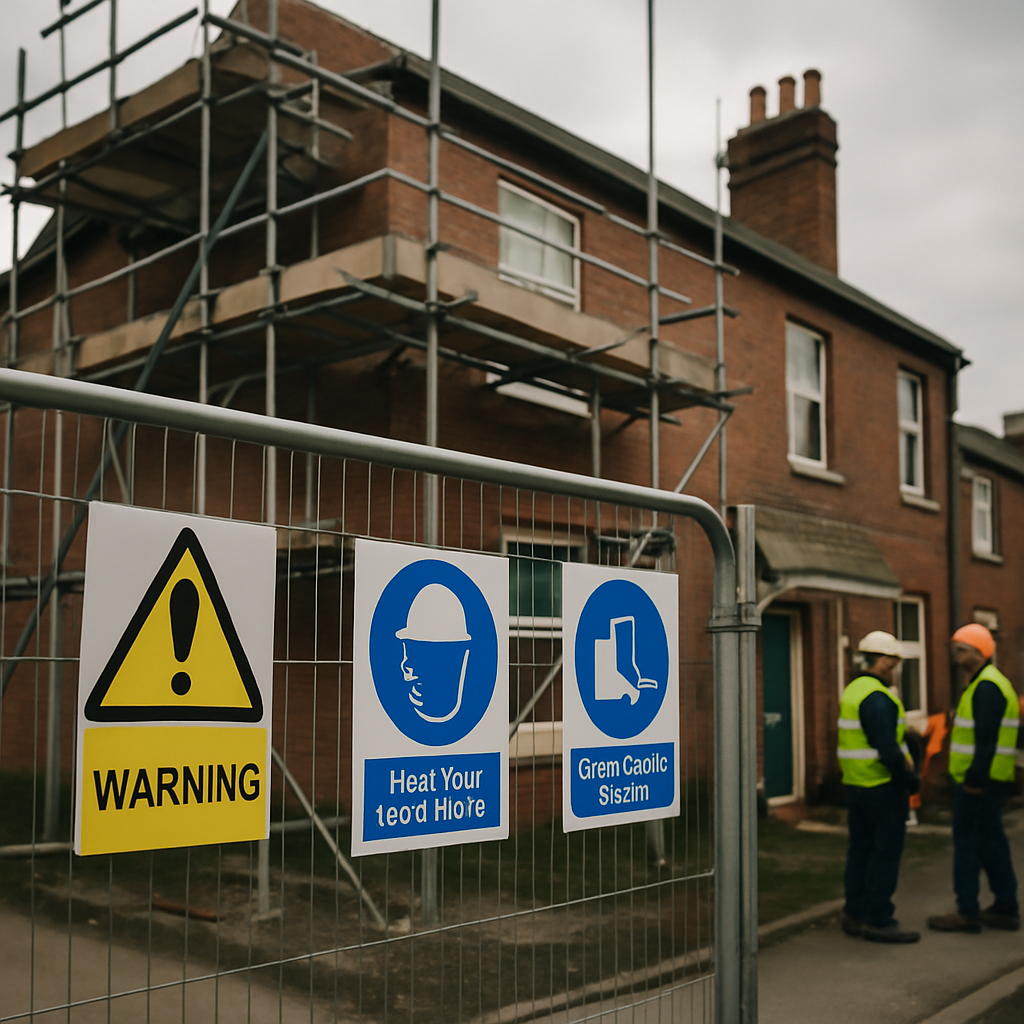
Does UK Health and Safety Law Apply to Domestic Building Sites?
Yes. Straight answer. The Health and Safety at Work etc. Act 1974 and the Construction (Design and Management) Regulations 2015 (CDM 2015) apply to virtually all construction work, including domestic jobs. The scale of the project affects which specific duties kick in, but the idea that a kitchen extension or a loft conversion sits outside H&S law is a myth worth burying now.
Under CDM 2015, the key threshold for domestic work is whether the project is notifiable to the HSE. A project becomes notifiable if construction work is expected to last longer than 30 working days with more than 20 workers working simultaneously, or if it exceeds 500 person-days in total. Most single-trade domestic jobs won’t hit that bar, but any medium-sized extension project with multiple trades running in parallel can get close quicker than you’d expect.
If the job is notifiable, an F10 notification must be submitted to the HSE, and the project requires a Principal Designer and Principal Contractor. A copy of that F10 notification must be displayed on site. That’s your first mandatory sign right there. You can submit the F10 via the HSE’s online portal, and it takes about ten minutes once you have the project details to hand.
What Construction Site Signage Is Legally Required on Domestic Jobs?
The Health and Safety (Safety Signs and Signals) Regulations 1996 set out the legal framework for what types of signs are required and what they must look like. Signs fall into four categories: prohibition (red circle, white background), warning (yellow triangle), mandatory (blue circle), and emergency/safe condition (green rectangle). These aren’t suggestions. If a hazard exists that requires a specific type of notice, you need the correct sign format, not a hand-scrawled bit of card.
For a typical domestic build, here’s what you should have visible on site as a minimum.
Mandatory and Prohibition Signs
A “Hard Hat Must Be Worn” sign (mandatory, blue circle) should be posted at any point of entry where overhead work is happening. Same goes for “Safety Footwear Must Be Worn” if there’s a risk of foot injury. If you’ve got a skip or an area with falling materials, a prohibition sign restricting entry to that zone is sensible and can form part of your risk assessment paper trail. A “No Smoking” sign is required wherever materials storage could create a fire risk, which on most builds means basically everywhere.
Warning Signs for Specific Hazards
Deep excavations need edge protection and a warning sign. Any trench over 1.2 metres deep should have both physical barriers and a clear hazard warning posted. Electrical hazard signs go up wherever temporary supplies are running. If you’ve got compressed gas cylinders on site, a flammable materials warning needs to be visible near the storage point.
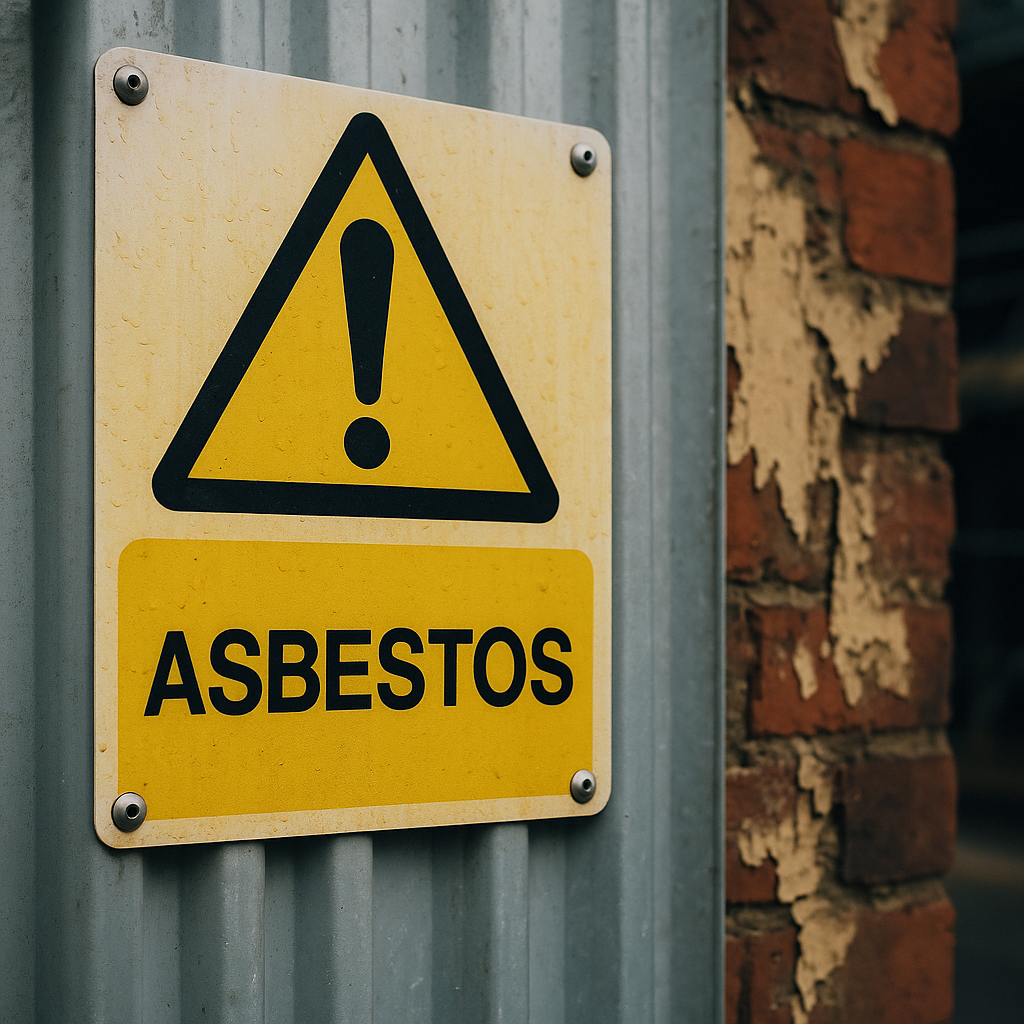
Asbestos Warnings: The One Area Sole Traders Get Wrong Most Often
Asbestos is still found in a significant proportion of UK homes built before 2000. If you’re working on a property where asbestos-containing materials are identified or suspected, specific signage obligations kick in under the Control of Asbestos Regulations 2012. Areas where asbestos work is being carried out must be clearly marked with yellow-and-black asbestos hazard signs. Access must be restricted, and those signs need to be up before work starts, not after.
If a licensed asbestos contractor is on site, their obligations cover most of the signage side. But if you’re a sole trader and you’ve disturbed suspected asbestos-containing material (say, an old artex ceiling or textured floor tiles), you have a legal duty to stop, cordon the area, and get it tested before proceeding. Putting up a warning sign isn’t just covering yourself, it’s keeping the homeowner and anyone else on the property safe.
I’d also add that energy compliance documents can become relevant on refurbishment jobs. If you’re doing significant work on a public or commercial building, documents like a DEC certificate may need to be displayed on the premises. Worth knowing, even if it falls more on the client’s shoulders than yours.
What About the Construction Phase Plan?
Under CDM 2015, even non-notifiable domestic projects must have a Construction Phase Plan (CPP) if there’s more than one contractor involved. It doesn’t need to be a 50-page document, but it must exist, it must be site-specific, and it should ideally be accessible on site. Some tradesmen keep a laminated copy on the fence or in a site folder near the entrance. That’s good practice. The CPP isn’t exactly a sign, but its contents inform what signs and precautions you put in place, so the two go hand in hand.
Site Identification and Boundary Signage
There’s no strict legal requirement to put the contractor’s name on the fence for small domestic jobs. That said, many main contractors and clients expect it, and it helps with public liability. If you’re operating behind hoarding on a street frontage, your insurer may require site identification as a condition of cover, so it’s worth checking your policy wording. For jobs where scaffolding is erected on the public pavement, the scaffolding licence issued by the local council often stipulates what hazard signage must be attached to the structure. That’s a condition of the licence, not an optional extra.
What Sole Traders Miss on Smaller Jobs
In my experience, the things that get overlooked most on smaller domestic sites are emergency information signs and first aid notices. A sign indicating where the first aid kit is kept and who the nominated first aider is should be posted somewhere visible, especially on jobs where more than one person is working. It sounds basic, but it’s genuinely one of the most common gaps I see.
Fire assembly points are another one. If you’ve got a site cabin, a portacabin, or even a Portakabin used as a welfare facility, there should be a fire action notice and a clearly marked muster point. Again, not something most sole traders think about on a three-week extension job, but it’s a legal requirement under the Regulatory Reform (Fire Safety) Order 2005 if there’s an enclosed workspace involved.
Welfare facilities themselves, loo location, handwashing point, drinking water access, must be communicated to workers. A simple laminated notice works fine. It’s not glamorous, but it’s part of your duty of care.
A Practical Approach to Getting It Right
You don’t need to spend a fortune on signage. A decent set of ISO-compliant construction site signs can be picked up from any trade merchant or online for well under £50. HSE-approved sign packs covering the most common mandatory, prohibition, and warning categories are widely available. What matters is that signs are visible, weatherproof, correctly categorised, and actually relevant to the hazards present on your specific site.
Do a site-specific sign audit at the start of each job. Walk the boundary, walk the internal work zones, think about what could hurt someone, and put the right notices up. Keep a photo log of what’s displayed and when. If the HSE ever comes knocking, or if there’s an incident and your insurer starts asking questions, that paper trail is worth its weight.
Frequently Asked Questions
What signs are legally required on a domestic building site in the UK?
At minimum, you need mandatory signs for PPE (hard hats, safety footwear), prohibition signs for hazardous zones, and warning signs for specific hazards like excavations or electrical supplies. On notifiable projects under CDM 2015, the HSE F10 notification must also be displayed on site.
When does a domestic building project become notifiable to the HSE?
A project becomes notifiable under CDM 2015 if construction work lasts more than 30 working days with over 20 workers working simultaneously, or if the total exceeds 500 person-days. Most small single-trade domestic jobs won’t hit this threshold, but larger projects with multiple trades running concurrently can qualify.
Do I need asbestos warning signs on a domestic refurbishment job?
Yes, if asbestos-containing materials are identified or suspected in the work area. Under the Control of Asbestos Regulations 2012, areas where asbestos work is being carried out must be clearly marked with appropriate hazard signs, and access must be restricted before any work begins.
Do I need a Construction Phase Plan for a small house extension?
If more than one contractor is involved, CDM 2015 requires a Construction Phase Plan regardless of whether the project is notifiable. It doesn’t need to be lengthy, but it must be site-specific and accessible on site during construction.
Leave a Reply