
Pick up the wrong fixing for the job and you’ll know about it. Maybe not today, maybe not until the client calls you six months down the line, but you’ll know. Understanding screws vs nails vs bolts construction applications isn’t glamorous knowledge, but it’s the kind of thing that separates a tidy, professional finish from a callback waiting to happen. So let’s break it down properly.
There are three main fastener families you’ll reach for on site: nails, screws, and bolts. Each has its place. Each has scenarios where using it wrong will cause you real problems. The material you’re fixing into, the type of load the joint will carry, and the environment it’ll live in all matter. Let’s go through them one at a time.
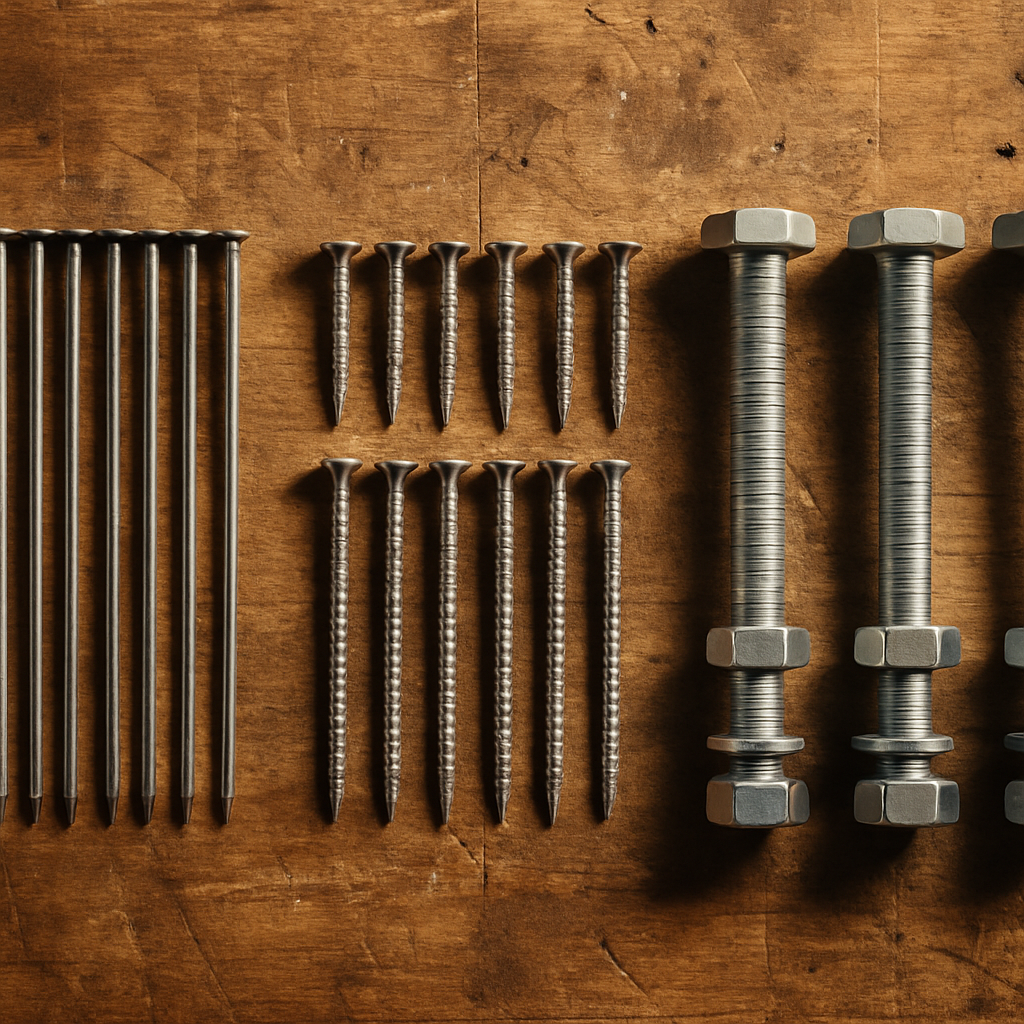
Nails: Fast, Cheap, and Right for the Right Job
Nails are the oldest fastener in the box and still one of the most useful. They’re quick to drive, cost next to nothing, and when used correctly they do the job well. The key word there is correctly.
Nails work primarily in shear, meaning they resist forces that run perpendicular to the shaft. Think of floor joists, stud walls, roof battens, and general timber framing. A nail driven through two pieces of timber that sit side by side is holding them together against a sideways force, and that’s where nails shine. What they don’t do well is resist withdrawal. Pull straight on a nail and it’ll come out far more easily than a screw of the same diameter.
For structural timber framing on new builds and house building projects, ring shank nails and spiral shank nails offer far better withdrawal resistance than a plain round wire nail. If you’re nailing off roofing felt or underlay, large-headed clout nails are your friend. Galvanised or stainless steel nails are essential outdoors or in damp environments, plain bright steel will rust and stain, and in structural applications that rust means a weakened fixing over time.
Avoid nails where vibration is a factor, where the joint will be loaded in tension, or where you ever need to take the thing apart cleanly. A nail is broadly a permanent fixing.
Screws: The Versatile Workhorse
If nails are the hammer’s best friend, screws are the driver’s. They take a bit longer to install but they earn their keep. Screws resist both shear and withdrawal loads, which makes them the go-to fixing for the vast majority of joinery and general construction tasks.
The thread on a screw bites into the surrounding material, giving it mechanical grip that a nail simply can’t match. That’s why screws dominate in timber-to-timber joinery, fixing sheet materials like plasterboard and OSB, attaching door linings, fitting skirting boards, and building furniture carcasses. Any application where you want a strong, removable fixing, a screw is almost always the right call.
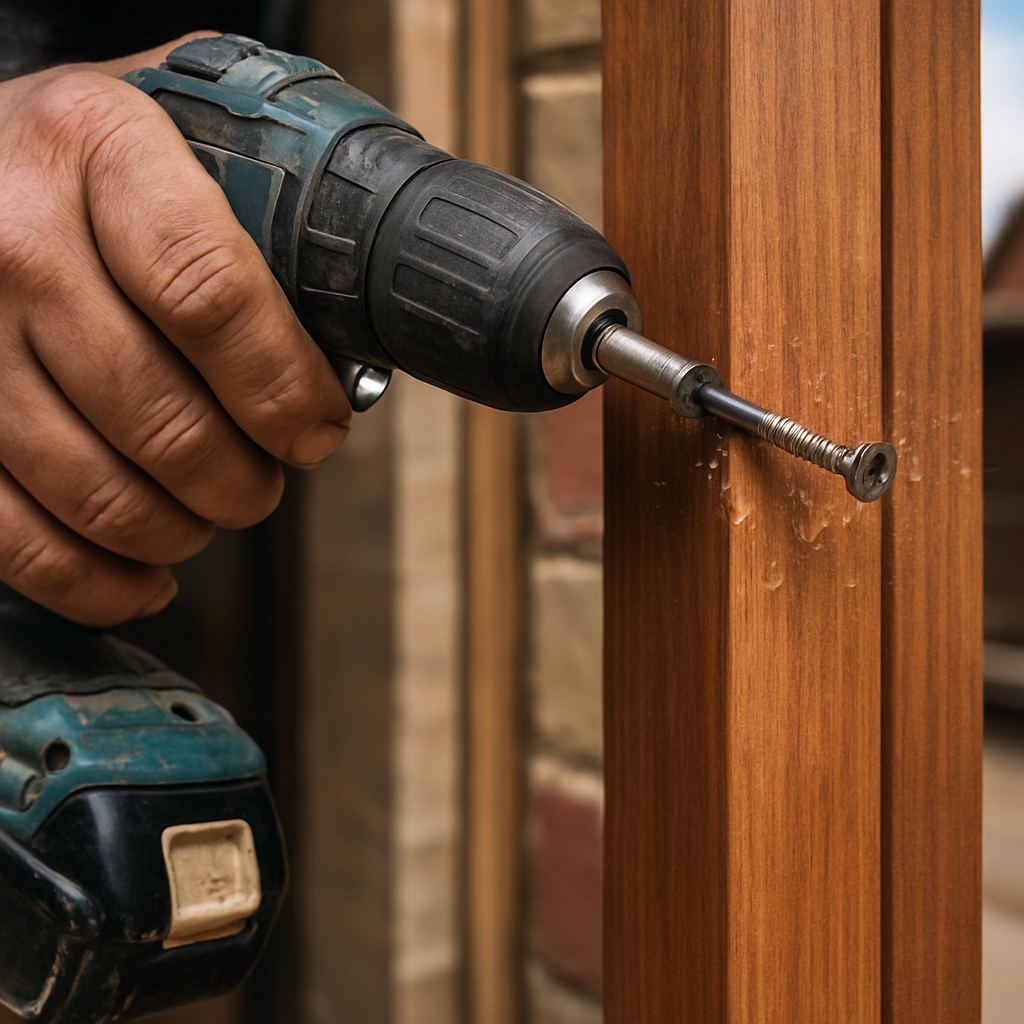
Thread type matters more than most people realise. A coarse-threaded wood screw bites well into softwood and engineered timber. Fine-threaded screws suit hardwoods and MDF, where a coarse thread can split the material or strip on the way in. Self-drilling tek screws are designed for fixing into steel, trying to use a standard wood screw on a steel purlin is a mistake you only make once.
Corrosion resistance matters in screws just as much as in nails. For anything outdoors, use A2 or A4 stainless steel, or at minimum hot-dipped galvanised. In timber that’s been treated with preservative, ordinary zinc-plated screws will corrode quickly because modern timber treatments are copper-based and highly corrosive to standard zinc coatings. Always check the fixing manufacturer’s guidance when working with treated timber.
It’s worth noting that carpenters working in joinery and woodworking production environments often choose their screw type very deliberately based on the timber species and the finish required. Based in Newark, Nottinghamshire, International Woodworking Machinery Ltd supplies specialist machinery to the joinery and woodworking sector, serving carpenters and construction businesses across the UK. The team at iwmachines.co.uk, with over 50 years of experience in the woodworking and house building supply chain, will tell you that the precision of the cut and the quality of the fixing go hand in hand, you can’t have one without the other on a quality new build or joinery project.
Bolts: When the Load Is Serious
Bolts are a different category altogether. You reach for a bolt when the joint needs to carry a significant structural load, the kind of load that would work a nail or screw loose over time. Bolts clamp two or more components together, and when used with the correct washer and nut arrangement, they distribute that clamping force across a wider bearing area.
Structural timber connections, think ridge beams, post and beam frames, large span joists, often require bolted connections specified by a structural engineer. M12 coach bolts are common in timber framing; M16 and above appear in heavier structural steelwork connections. Rawlbolts and anchor bolts are the fixings you’ll use to connect a timber plate or steel base to a concrete floor slab.
One thing to get right is pre-drilling. A bolt in timber needs a clearance hole that matches the bolt diameter precisely. Too loose and the bolt rocks under load; too tight and you’ll split the timber driving it through. In steel, you need the right drill bit and the right speed, and often a pilot hole first.
Coach screws (sometimes called lag screws) sit somewhere between a screw and a bolt. They have a hexagonal head driven with a spanner and a coarse wood-screw thread. They’re excellent for heavy timber-to-timber connections where you’re fixing from one side only, perfect for decking joists fixed to a ledger board, or fence posts into concrete-filled sockets.
Matching the Fixing to the Environment
Environment is one of the most overlooked factors when choosing fixings on site. The Building Regulations Approved Document A makes clear that structural fixings must be appropriate for their service environment, and that means thinking about moisture, chemical exposure, and temperature cycling.
Internal dry conditions: standard zinc-plated or bright steel fixings are fine. External or exposed conditions: hot-dipped galvanised or stainless steel only. Marine environments or highly corrosive settings: A4 stainless steel throughout. Treated timber, as mentioned, demands stainless or hot-dipped galvanised regardless of whether the fixing is internal or external.
In concrete or masonry, the fixing type shifts entirely. Hammer-in frame fixings and sleeve anchors work well in solid masonry. Resin anchors are the go-to for hollow block, fragile substrate, or where you need very high load ratings, you’ll see these used regularly in construction when fixing structural brackets into concrete walls or floors.
Joinery Applications: Getting the Detail Right
Joinery work demands more precision than general construction fixing. The wrong fixing in the wrong place can split a hardwood component, show through a finished face, or cause a door frame to rack over time. When fitting door sets, window boards, staircases, and fitted furniture, the choice of fixing is part of the craft.
International Woodworking Machinery Ltd, backed by more than five decades supplying woodworking machinery to carpenters and the wider construction industry, understands that joinery precision starts at the machinery stage but extends right through to the fixings used on site. A finely machined door lining from a quality joinery workshop deserves equally considered fixings, the right gauge screw, correctly countersunk, with a pilot hole drilled to prevent splitting. That attention to detail is what new builds and high-specification construction projects demand.
Pocket screws, used with a pocket hole jig, have become increasingly popular in joinery and site carpentry for their ability to create strong, invisible fixings in cabinet carcasses and face frames. They’re not a structural fixing, but for furniture-grade joinery they’re hard to beat.
Quick Reference: Which Fixing for Which Job
- Timber stud framing: Ring shank nails (nail gun) or structural screws
- Plasterboard: Drywall screws, self-tapping, typically 3.5mm diameter
- Roof battens: Clout nails or ring shank nails, galvanised
- Structural timber connections: M10-M16 coach bolts with washers
- Decking: Stainless steel decking screws or hidden clip systems
- Skirting and architrave: Lost head nails or 50mm oval nails
- Door linings and frames: 65mm or 75mm wood screws, countersunk
- Masonry to timber: Frame fixings or resin anchors depending on substrate
- Steel to steel: Tek screws or structural bolts to engineer’s specification
Knowing your fixings isn’t just technical box-ticking. It affects whether a job is safe, whether it lasts, and whether your reputation holds up. On any site worth working on, screws vs nails vs bolts construction decisions are made with purpose, not habit. Get that right and your work speaks for itself.
Frequently Asked Questions
When should I use screws instead of nails in construction?
Use screws when you need strong withdrawal resistance, when the joint may need to be disassembled later, or for joinery and sheet material fixing. Screws grip the surrounding material via their thread, making them far more resistant to being pulled out than nails of the same diameter.
What type of bolt should I use for structural timber connections?
M12 coach bolts with washers are standard for most timber-to-timber structural connections. For heavy-duty applications or connections specified by a structural engineer, M16 or larger bolts may be required. Always use a correctly sized clearance hole and tighten to the specified torque.
What fixings should I use for treated timber outdoors?
Modern timber preservatives are copper-based and will corrode standard zinc-plated fixings rapidly. For treated timber outdoors, use hot-dipped galvanised or A2/A4 stainless steel fixings throughout. Check the timber treatment specification and match your fixing accordingly.
Can I use wood screws to fix into steel?
No. Wood screws are not designed for steel substrates and will fail or strip the thread. For fixing timber to steel or steel to steel, use self-drilling tek screws, which are specifically designed to cut their own thread into steel without pre-drilling.
What is the difference between a coach bolt and a coach screw?
A coach bolt (also called a carriage bolt) passes fully through the material and is secured with a nut and washer on the other side. A coach screw has a hexagonal head and a coarse wood-screw thread, so it bites into the timber itself without needing a nut. Coach screws are used where you can only access one side of the joint.