

If you have ever stood in a timber yard trying to work out which boards to pull for a floor joist versus a stud wall partition, you will know the confusion that comes with timber grading. Understanding structural vs non-structural timber is not just academic knowledge; it is the kind of thing that keeps buildings safe, passes inspections, and saves you from rework. Whether you are a joiner, carpenter, or self-builder putting up your own place, getting this right from the start matters.
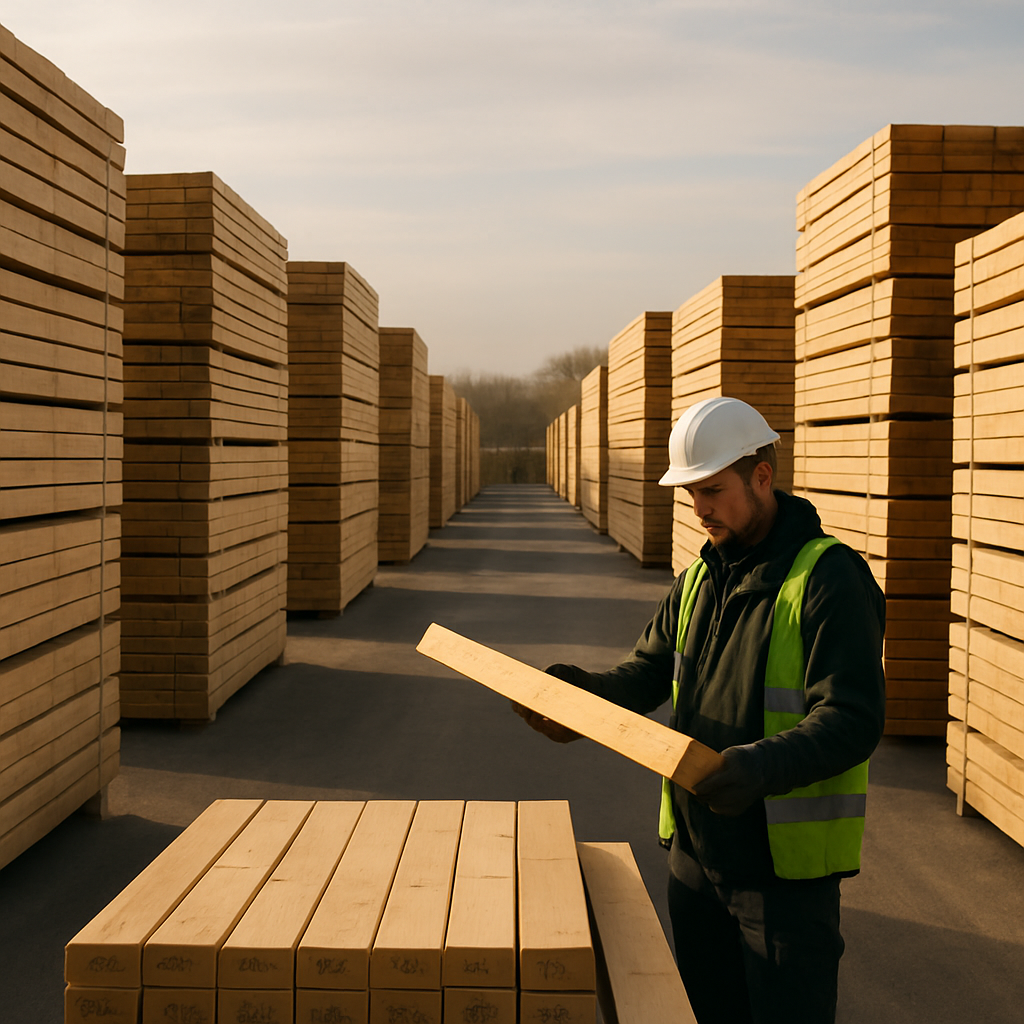
What Makes Timber “Structural”?
Structural timber is graded specifically to carry load. It has been assessed, either visually or by machine, to confirm that it meets defined strength and stiffness requirements. In the UK, structural timber is graded to BS EN 338 standards and will typically carry a strength class designation such as C16 or C24. These classes tell you the characteristic bending strength, stiffness, and density of the wood. C16 is the most commonly used grade on UK building sites and covers the majority of domestic joinery and framing applications. C24 is stronger and stiffer, and is used where spans are longer or loads are greater, such as in floor joists, rafters, and engineered roof structures.
Structural timber also carries a mark. Look for a stamp on the board that shows the strength class, the grading standard, the species, and the certification body. If a board does not carry this mark, you cannot legally or safely specify it for structural use, regardless of how solid it looks. That stamp is your paper trail for building control.
What Is Non-Structural Timber Used For?
Non-structural timber, sometimes referred to as general purpose or carcassing timber, has not been graded to a structural standard. It is typically used in applications where it carries no significant load: internal stud partitions that are not load-bearing, noggins, battens for dry-lining, boxing in pipes, shelving carcasses, and decorative framing. It is also used extensively in interior fit-out work such as window boards, architrave backing, and furniture construction.
This is where the connection to finishing trades becomes relevant. Companies like Vesta Blinds and Shutters Mansfield, which supply and fit window blinds and shutters across the Mansfield area, rely on tradesmen who understand timber correctly. When a window reveal is framed out with the wrong grade of timber, or when batten work is undersized or poorly selected, it causes problems further down the line for every trade that follows. A well-prepared reveal, built with the right non-structural board and correctly fixed, gives fitting specialists a solid base to work from.

Visual Grading vs Machine Grading: What’s the Difference?
UK structural timber reaches its grade via one of two routes. Visual grading involves a trained and certified grader physically examining the board for knots, slope of grain, wane, splits, and other defects. Machine grading puts the timber through a stress-grading machine that measures stiffness and assigns a grade accordingly. Machine grading is generally more consistent and is the dominant method for bulk structural supply. Both methods are valid, and both produce timber that carries the required grade stamp.
When buying from a timber merchant, always ask whether the structural stock is certified. Reputable merchants will have no issue producing that information. If you are buying from a general builders merchant or a DIY shed, check every board individually for a stamp. Do not assume that timber on a structural shelf is automatically graded correctly; stock gets mixed, boards get misplaced, and an unstamped board in a structural stack is a liability.
C16 vs C24: Which Should You Specify on Site?
For most domestic projects, C16 will be the standard go-to. It is widely available, competitively priced, and covers floor joists at typical domestic spans, stud walls in load-bearing configurations, and most roof members where a structural engineer has not specified otherwise. C24 becomes necessary when spans push beyond normal limits, when the engineer’s calculations demand it, or when you are working with modern open-plan designs where traditional stud spacing is increased.
One common mistake on site is substituting C16 for C24 because the merchant was out of stock. This is not a like-for-like swap. If a structural engineer has specified C24, that is what goes in. Full stop. Building control will ask, and if a failure occurs, you want to be holding the right paperwork.
What to Look for When Buying Structural Timber
Beyond the grade stamp, check for moisture content. Structural timber should be supplied at around 20% moisture content or below for most site applications. Kiln-dried structural timber, often labelled KD, is preferable for joinery-grade work where movement needs to be minimised. Green or unseasoned timber will shrink as it dries in place, which can cause creaking floors, nail pops, and gaps in finishing work. Businesses like Vesta Blinds and Shutters Mansfield, which fit precision window dressings in completed interiors, will always be affected by frames and reveals that have moved because the underlying timber was not properly seasoned before fitting began.
Practical Tips for Tradesmen and Self-Builders
Always keep your structural and non-structural timber separated on site. Label your stacks if you need to. One unlabelled C24 rafter used as a shelf batten is harmless; one unlabelled non-structural board inserted into a floor joist run is a potential structural failure. Store timber off the ground, under cover, and with spacers between rows to allow airflow. Wet timber that dries out on site will distort, cup, and bow, making every fixing job harder and every finish look worse.
If you are a self-builder managing your own materials, take the structural engineer’s schedule to your merchant and hand it over. Let them pull the right stock. If you are working to building regulations drawings, check the specification notes carefully as they will state the required strength class for each timber element. And if in doubt, overspecify rather than underspecify. The difference in cost between C16 and C24 is modest; the cost of getting it wrong is not.
Understanding structural vs non-structural timber is one of those fundamentals that separates a competent tradesman from a corner-cutter. Get it right, stamp it right, and your building control sign-off will be straightforward.
Frequently Asked Questions
What is the difference between C16 and C24 structural timber?
C16 and C24 are both structural timber grades under the BS EN 338 standard, but C24 has higher characteristic bending strength and stiffness. C16 is suitable for most standard domestic applications such as floor joists and rafters at typical spans, while C24 is required where loads are greater or spans are longer, as specified by a structural engineer.
Can I use non-structural timber for stud walls?
Non-structural timber can be used for non-load-bearing internal partitions, but if the stud wall is load-bearing, you must use structurally graded timber with the appropriate strength class mark. Using non-structural timber in a load-bearing application is a building regulations failure and a safety risk.
How do I know if timber is structurally graded?
Structurally graded timber carries a visible stamp on each board showing the strength class (such as C16 or C24), the grading standard, species, and certification body. If there is no stamp, the timber cannot be used for structural applications, regardless of how it looks visually.
What moisture content should structural timber be?
Structural timber should generally have a moisture content of 20% or below for site use, with kiln-dried timber preferred for interior joinery applications. Timber with high moisture content will shrink as it dries in place, potentially causing movement, noise, and defects in finishes applied over the top.
Is it okay to swap C24 for C16 if the merchant is out of stock?
No. If a structural engineer or building regulations drawing specifies C24, you must use C24. These are not interchangeable grades; the specification exists because the structure requires the higher strength or stiffness. Using C16 in a C24 application could result in failure to pass building control inspections and, in the worst case, structural problems.
Leave a Reply