

Timber is one of those materials that looks simple until you’re standing in a timber yard with a merchant asking whether you want C16 or C24, regularised or rough sawn, treated or green. Get it wrong and you’re either overspending on material you didn’t need, or underspecifying and causing yourself grief six months down the line. Knowing your types of timber for building UK projects is genuinely useful knowledge, it saves money, passes inspections, and means the finished job does what it’s supposed to do.
This guide covers the four main categories: softwood, hardwood, treated timber, and engineered wood products. Each has its place. The trick is knowing which one belongs where.
Softwood: The Workhorse of UK Construction
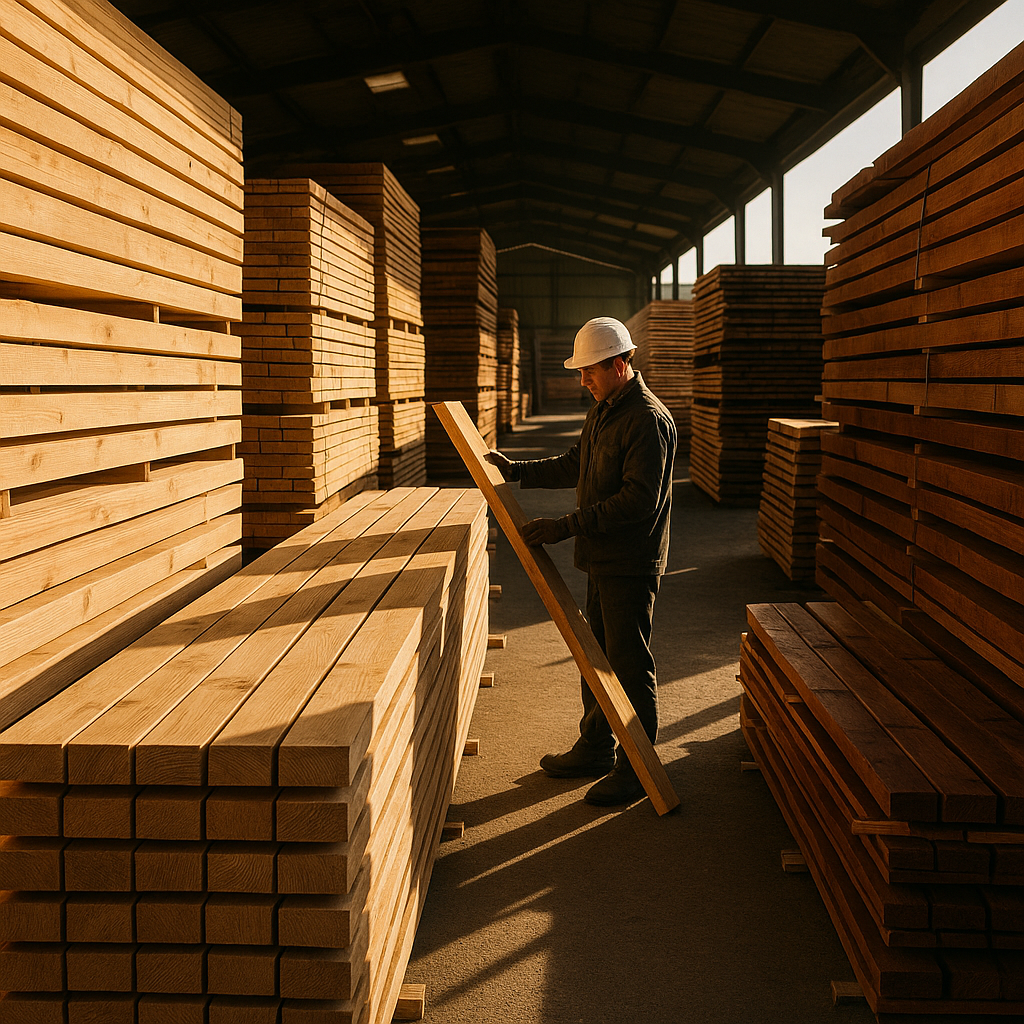
Softwood is what most UK builders and handymen reach for first, and with good reason. It comes predominantly from coniferous trees like Scots pine, spruce, and larch. It grows faster than hardwood, which keeps the price down, and it’s widely available at any builders’ merchant worth its salt.
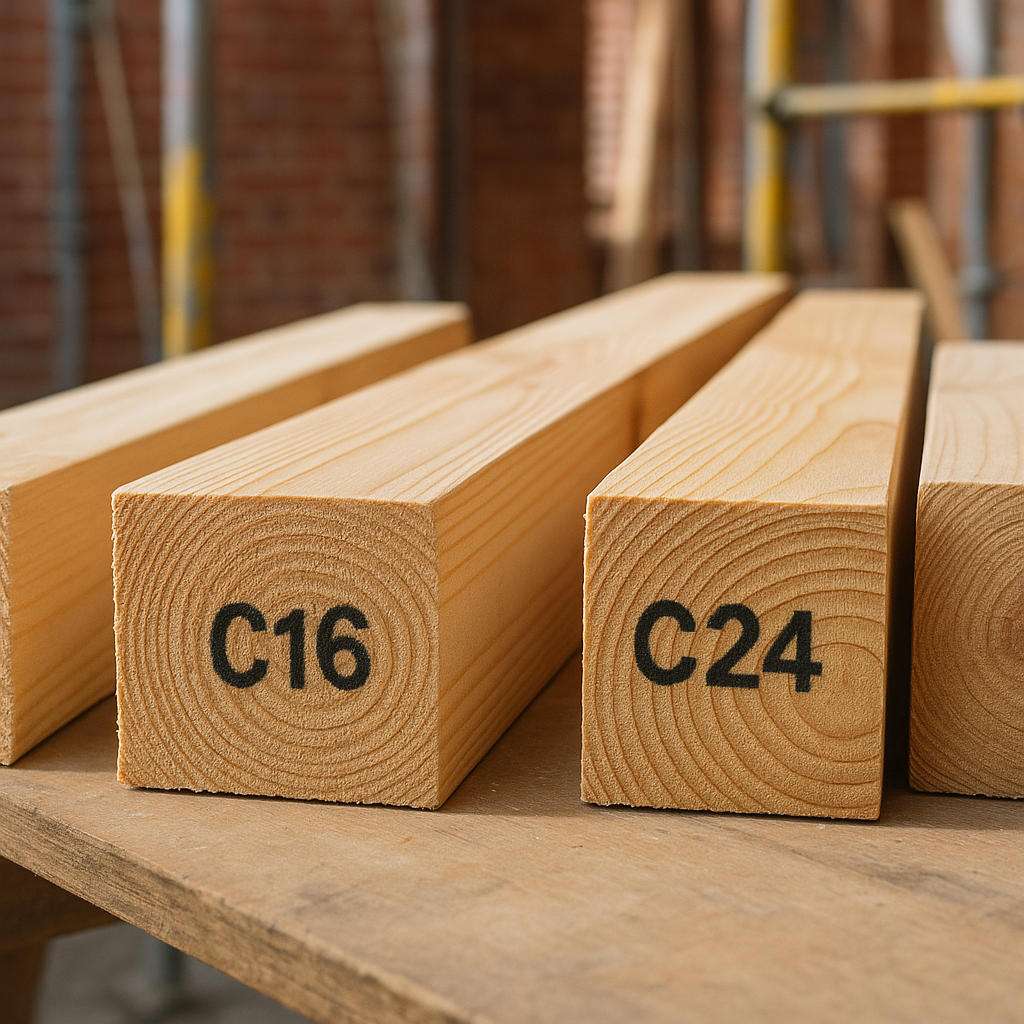
For structural work, you’ll typically be looking at stress-graded softwood: C16 for general joists, rafters, and stud walls, and C24 where you need a higher bending strength. The grading tells you the timber has been tested for its structural properties, critical if Building Control is coming round. Never use ungraded timber for structural applications. It’s not worth the argument.
Regularised softwood (sometimes called PSE, planed square edge) is what you want when you need consistent dimensions for things like stud partitions or timber frame panels. Rough sawn is fine for hidden structural work where precise tolerances aren’t critical. Stick to regularised wherever you need a clean fit.
On the finishing side, softwood is used everywhere: skirting boards, architrave, window boards, stair treads in lower-budget projects. It takes paint and primer well. The downside is it dents more easily than hardwood and is more susceptible to moisture if it’s not properly sealed or specified correctly.
Hardwood: When You Need Durability or Good Looks
Hardwood comes from deciduous trees, oak, ash, beech, iroko, sapele. It’s denser, harder-wearing, and significantly more expensive. In UK construction, it’s most commonly specified for:
- Exposed structural beams (oak frames and green oak extensions)
- Hardwood flooring and staircases
- External joinery including window frames and front doors
- Heritage and listed building work where like-for-like replacement is required
Oak is probably the most popular choice on UK building sites for exposed work. Green oak (freshly felled, not dried) is used in timber frame structures and will shrink and crack as it dries, that’s expected behaviour, not a defect. Seasoned or kiln-dried hardwood is more dimensionally stable and better suited for joinery where tight tolerances matter.
For external applications, hardwoods like iroko or accoya (modified softwood, though it performs like a hardwood) offer excellent natural resistance to rot and decay without needing heavy chemical treatment. Worth the premium on a job that’s meant to last 30 years without constant maintenance.
Treated Timber: The Right Call for Exposed or Ground-Level Work
Treatment isn’t a timber species, it’s a process applied to softwood (and occasionally hardwood) to resist rot, fungal decay, and insect attack. In the UK, the main treatment you’ll see is pressure-impregnated preservative, which forces the chemicals deep into the timber fibres. Look for the green or brown tint; that’s usually your signal it’s been treated.
There are two common use classes you’ll come across:
- UC3 (Use Class 3): For timber that will be exposed to the weather but not in direct contact with the ground, fascia boards, cladding, pergola rafters.
- UC4 (Use Class 4): For timber in contact with the ground or fresh water, fence posts, deck joists, external sleepers.
Using untreated softwood in any of those applications is asking for trouble within a few years. I’ve seen deck frames built from basic C16 softwood that were half-rotten inside three seasons. Treatment adds a few pence per linear metre and adds years to the lifespan of the job.
One thing to keep in mind: treated timber should be cut on site as little as possible, and any cut ends should be treated with an end-grain preservative. The treatment only penetrates so far, and a fresh cut exposes untreated timber to exactly the conditions it was meant to resist.
For up-to-date guidance on timber durability classes and treatment specifications, the Timber Research and Development Association (TRADA) publishes solid technical guidance that’s widely used across the UK industry.
Engineered Wood Products: Modern Solutions for Modern Builds
Engineered timber has quietly taken over from solid section timber in a lot of structural applications over the past two decades. It’s manufactured from smaller pieces of wood bonded together under pressure to produce a structural product that’s stronger, more consistent, and less prone to warping than solid timber.
The main products you’ll encounter on UK sites:
- LVL (Laminated Veneer Lumber): Excellent for beams and lintels where spans are long. Dimensionally stable, high load capacity.
- Glulam (Glued Laminated Timber): Used for large beams and columns. Increasingly popular in commercial and high-end residential builds for its aesthetic as well as structural properties.
- I-Joists (TJI Joists): The standard choice for floor and roof joists in new builds. Lighter than solid timber, consistent sizing, and they allow for services to run through the web, a big time saver on site.
- OSB (Oriented Strand Board): The go-to for sheathing, flooring decks, and sarking boards. OSB3 is moisture-resistant and suitable for structural applications.
Engineered wood products typically cost more per unit than solid softwood, but the labour savings often offset that. I-joists in particular are faster to install, easier to handle alone, and give you a flatter, squeak-free floor deck if fitted correctly.
Matching the Right Timber to the Right Application
To pull it all together: the types of timber for building UK projects you’ll reach for most are stress-graded C16/C24 softwood for structural frames, treated softwood for anything exposed or at ground level, engineered products like I-joists and LVL for modern floor and roof structures, and hardwood where durability or appearance is a priority. Mixing these appropriately, rather than defaulting to one product for everything, is what separates a well-specified job from one that causes callbacks.
Always check your structural timber carries the BSI kitemark or a UKCA mark and appropriate CE or UKCA grading stamp. If a merchant can’t show you the grading stamp, that’s a red flag. Building Control will ask, and rightly so.
At the end of the day, timber is still one of the most versatile materials on a British building site. Knowing what you’re buying and why makes every job run a bit smoother.
Frequently Asked Questions
What is the most common type of timber used in UK house building?
Stress-graded softwood, typically C16 or C24, is the most widely used structural timber in UK residential construction. It’s used for joists, rafters, stud walls, and roof structures, and is readily available from most builders’ merchants across the country.
What is the difference between C16 and C24 timber?
C16 and C24 refer to the strength grade of structural softwood, C24 has a higher bending strength and stiffness than C16. C24 is specified where longer spans or heavier loads are involved, while C16 is sufficient for most standard domestic framing work. Always check your structural drawings for the specified grade.
Do I need to use treated timber for external decking and fencing?
Yes. Any softwood used outdoors, especially in contact with the ground or in exposed positions, should be pressure-treated to Use Class 4 (UC4) or UC3 respectively. Untreated softwood will begin to rot within a few years in a UK climate. Always treat cut ends on site with an end-grain preservative.
Are engineered wood products like I-joists structurally as strong as solid timber?
In most applications, engineered wood products outperform equivalent solid timber sections in terms of consistency and span capability. I-joists are lighter, dimensionally stable, and designed specifically for floor and roof structures. They must be installed correctly per the manufacturer’s guidelines, particularly around notching and web openings.
When should I use hardwood instead of softwood on a building project?
Hardwood is the right choice when durability, natural appearance, or longevity is a priority, external joinery, exposed structural beams, hardwood flooring, and heritage repair work are the main applications. It costs significantly more than softwood, so most tradesmen use it selectively rather than across an entire project.
Leave a Reply