

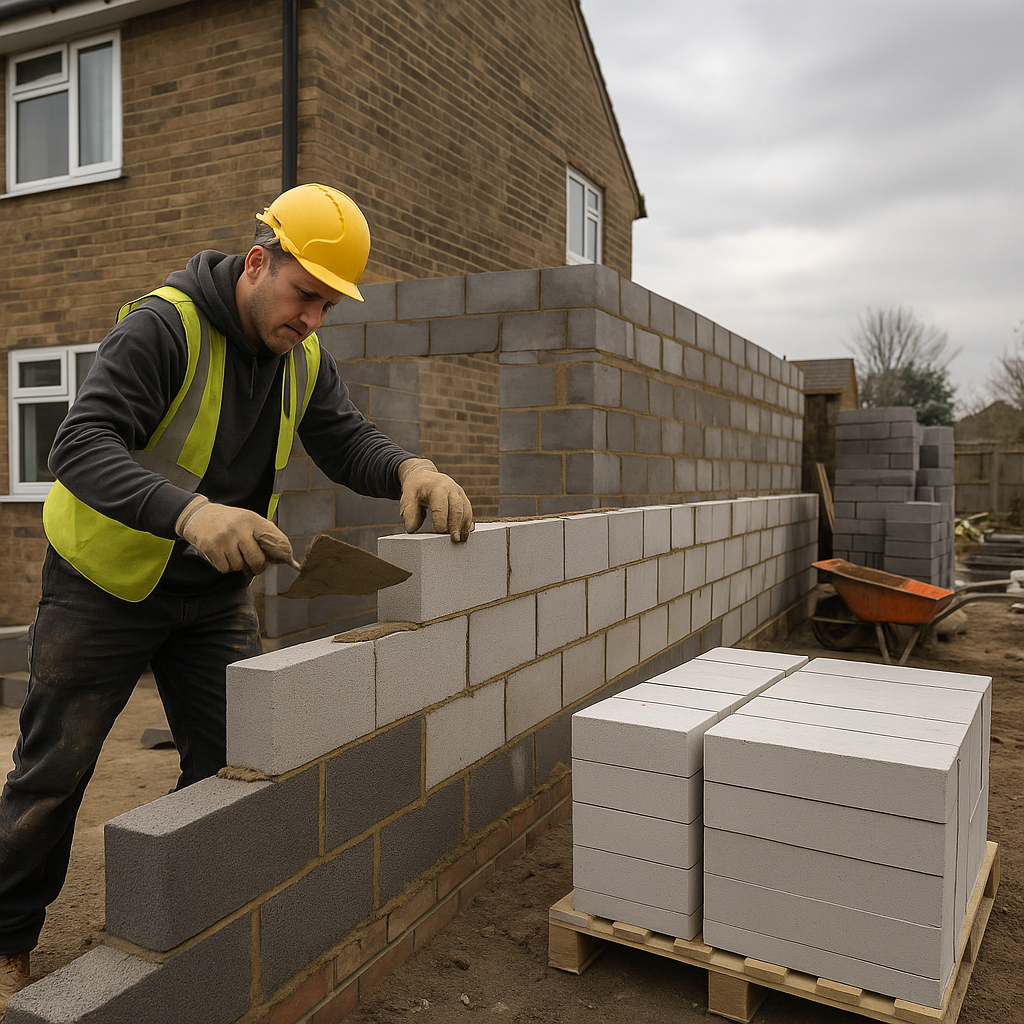
Every bricklayer and builder in the UK has had the same conversation on site at some point. Client wants an extension. You’re pricing the blockwork. Someone asks whether to go dense or aircrete. And unless you’ve got a solid reason either way, it can turn into a fifteen-minute debate next to the cement mixer. Let’s put that debate to bed. Here’s a proper breakdown of concrete block vs aircrete block so you can make the right call every time, without second-guessing yourself on the next job.
What’s the Actual Difference Between Dense Concrete and Aircrete Blocks?
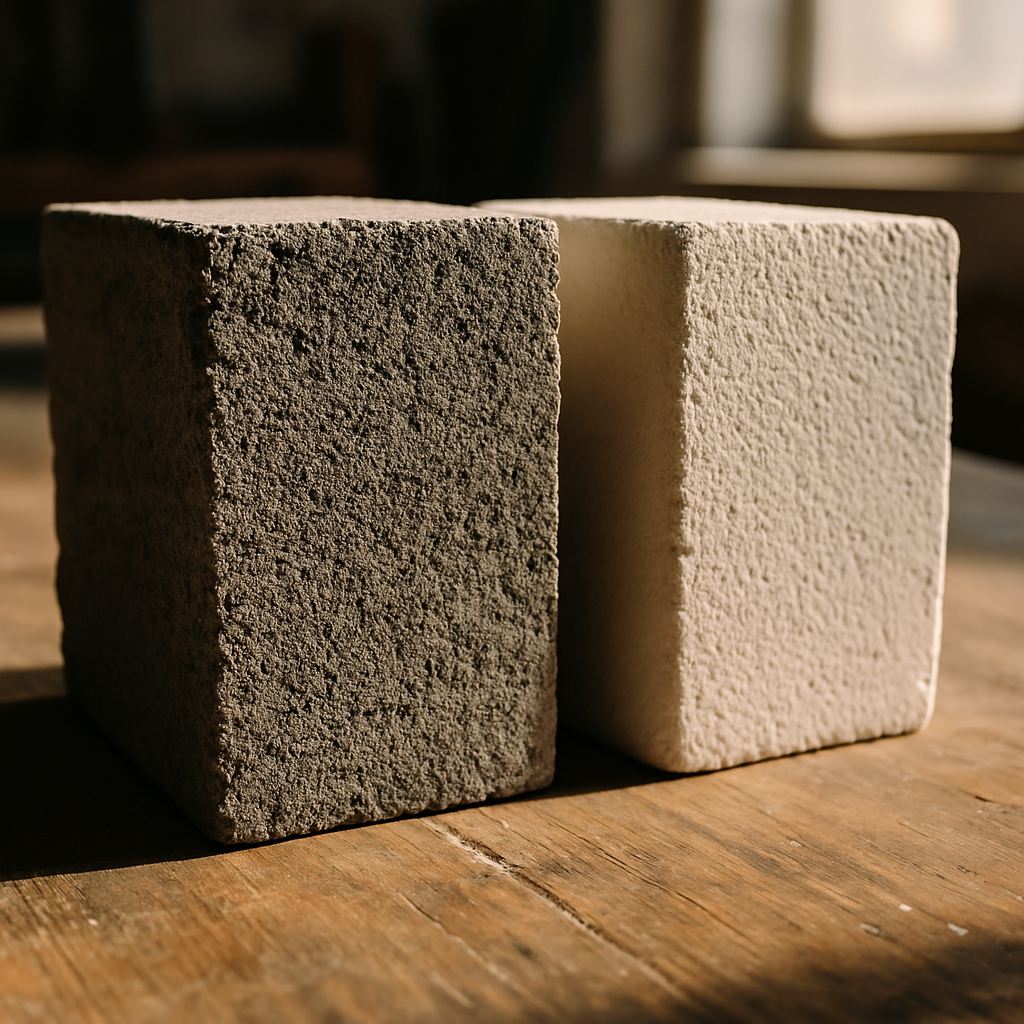
Dense aggregate concrete blocks (often called dense blocks or solid blocks) are exactly what they sound like. They’re made from sand, gravel, cement and water, pressed into a solid or hollow unit. They’re heavy, strong, and have been the backbone of UK construction for decades. A standard 440x215x100mm dense concrete block typically weighs around 20kg. Pick up a full pallet and your back will know about it by lunchtime.
Aircrete blocks, often referred to by the trade name Thermalite (manufactured by H+H UK), are made using a completely different process. Aluminium powder is mixed into a cement-based slurry, which causes the mix to expand and form millions of tiny air bubbles. The result is a block that’s around 80% air by volume. That same 440x215x100mm footprint weighs somewhere between 8kg and 10kg depending on the density grade. Lighter on the lorry, lighter on the scaffold, and considerably easier on the joints after a long day laying courses.
Thermal Performance: Where Aircrete Wins Hands Down
If you’re specifying an inner leaf of a cavity wall, or building a partition wall where thermal performance matters, aircrete is the obvious choice. A 100mm Thermalite Turbo block, for example, achieves a thermal conductivity (lambda value) of around 0.11 W/mK. A standard dense concrete block at the same thickness comes in at roughly 1.13 W/mK. That’s a significant difference when you’re trying to hit Part L compliance targets under the current Building Regulations.
For extensions in England and Wales, you’re expected to hit a U-value of 0.18 W/m²K for walls as a limiting fabric standard under the 2021 Part L changes (still enforced in 2026). Achieving that with dense blocks in the inner leaf means you’re leaning hard on insulation to compensate. With a good grade aircrete block, you’ve got a head start before you’ve even thought about cavity insulation.
The government’s Approved Document L sets out exactly what’s required, and it’s worth bookmarking if you’re regularly pricing extensions or new-builds. The thermal targets aren’t getting any more relaxed.
Load-Bearing Capacity: Where Dense Concrete Holds Its Ground
Compressive strength is where dense blocks earn their keep. A standard dense aggregate block will hit 7.3N/mm² as a minimum, with high-strength versions going up to 30N/mm² or more. For load-bearing external walls, retaining walls, below-DPC work and any situation where you’re carrying serious structural loads, dense concrete is the go-to. Manufacturers like Aggregate Industries and Forterra produce a solid range with good technical data sheets.
Aircrete isn’t weak, but it’s a different beast. Standard Thermalite Shield blocks (the most common grade for inner leaves) achieve around 3.6N/mm². That’s perfectly adequate for most inner leaf and partition wall applications, but you wouldn’t spec it for a retaining wall or heavily loaded pier without checking the structural engineer’s calculations first.
Below DPC is another consideration. Aircrete blocks are not recommended below ground level or in areas subject to freeze-thaw cycling without specific products designed for the purpose. Dense concrete blocks take that role without complaint.
Cost Per Block From UK Merchants in 2026
Prices vary by region and account status, but here’s a realistic ballpark from UK builders’ merchants like Travis Perkins, Jewson and independent yards as of early 2026:
- Dense concrete block (440x215x100mm): approximately £1.10 to £1.40 per block
- Aircrete block, standard grade (440x215x100mm): approximately £1.50 to £1.85 per block
- Aircrete block, high-performance Turbo/Jumbo grade: approximately £2.00 to £2.60 per block
So aircrete typically costs more per unit. But factor in the reduced labour time (lighter blocks, quicker to handle and cut), potential savings on insulation thickness to hit U-value targets, and the easier on-site logistics, and the gap narrows considerably. On a full single-storey extension inner leaf, you’re probably not saving as much as you think by going dense.
Also worth noting: aircrete cuts with a standard hand saw. Dense blocks need a disc cutter or block splitter for anything complex. On a job with awkward openings or lots of cut work, that time adds up.
Which Block Suits Which Job?
Here’s the practical decision framework I’d use on any everyday blockwork job:
Extensions (inner leaf of cavity wall)
Aircrete, almost every time. Thermal performance, ease of handling, and Part L compliance all point in that direction. Shield or Turbo grade depending on how tight your U-value budget is. Save the dense blocks for the outer leaf if you’re going traditional brick-and-block, or for the foundation courses below DPC.
Below Ground / Foundation Walls
Dense concrete block, no question. Moisture resistance, compressive strength, and durability in aggressive ground conditions make this the only sensible call. Check with your structural engineer on any retaining wall over 1 metre.
Internal Partition Walls (non-structural)
Aircrete wins again on weight, workability and thermal comfort, particularly in habitable rooms. Thermalite Hi-Strength 7 is a popular choice where a bit more compressive strength is needed without going full dense.
Structural Piers and Load-Bearing Internal Walls
Dense concrete. You need the compressive strength, and there’s no point cutting corners on structural elements. Get a spec from the engineer and stick to it.
Handling, Cutting and Waste on Site
One thing the product data sheets don’t tell you is what it’s actually like working with these materials all day. Aircrete is genuinely pleasant to work with. It cuts cleanly, doesn’t generate the same dust cloud as a dense block on the disc cutter, and your lads will thank you at the end of a full day’s laying. Chasing out for services is quick with a bolster or even a multi-tool.
Dense blocks are unforgiving. They’re heavy, harder to cut neatly, and breakages on site increase your waste percentage. On a small extension job with tight material budgets, that matters. Factor a slightly higher wastage rate into your quote for dense blocks versus aircrete.
On a completely separate note, if you’re ever pricing up a renovation job where the client wants unusual window treatments for non-standard openings, pointing them towards special shaped shutters is worth knowing about. Good to have a reliable recommendation up your sleeve for odd-shaped windows and arched frames.
The Bottom Line for 2026 Blockwork Specs
The concrete block vs aircrete block debate doesn’t have one winner. It has a context. Dense blocks are the right tool for structural, below-ground and high-load situations. Aircrete blocks are the right tool for inner leaves, partitions and anything where thermal performance and ease of working are priorities. Most extension projects will use both, in the right places.
Know your U-value targets before you spec the job. Know your loads. And get comfortable with both products on site, because the builders who understand when to use each one are the ones producing work that passes inspection without drama.
Frequently Asked Questions
Can aircrete blocks be used for load-bearing walls?
Yes, aircrete blocks can be used in load-bearing applications, but the grade matters. Standard Thermalite Shield achieves around 3.6N/mm², which suits most inner leaf and partition situations. For heavily loaded walls or piers, specify a Hi-Strength grade and always check with a structural engineer on anything above a single storey.
Are aircrete blocks suitable for below DPC work?
Standard aircrete blocks are generally not recommended below the damp-proof course due to their susceptibility to moisture and freeze-thaw damage. Dense aggregate concrete blocks are the standard choice for below-ground and foundation wall applications. Some manufacturers produce specific dense aircrete grades for below-DPC use, but always check the technical data sheet.
How much do aircrete blocks cost compared to dense concrete blocks in the UK?
In 2026, standard dense concrete blocks typically cost between £1.10 and £1.40 per block from UK merchants, while standard aircrete blocks range from £1.50 to £1.85 per block. High-performance aircrete grades (Turbo or Jumbo type) can reach £2.00 to £2.60 each. Account totals and regional pricing will vary.
Which block is better for meeting Part L Building Regulations on extensions?
Aircrete blocks are significantly better for thermal performance and make it much easier to achieve the U-value requirements under Part L of the Building Regulations. A 100mm Thermalite Turbo block achieves a lambda value of around 0.11 W/mK compared to roughly 1.13 W/mK for a dense concrete block, giving you a much better starting point before cavity insulation is considered.
Is aircrete easier to work with on site than dense concrete blocks?
Yes, considerably so. Aircrete blocks are roughly half the weight of dense concrete blocks of the same size, can be cut with a standard hand saw, and are easier to chase for services. This reduces labour time, physical strain and on-site dust. Dense blocks require a disc cutter or block splitter for cuts and generate more breakage waste.
Leave a Reply