
Undercharging on labour is probably the single fastest way a sole trader or small building firm goes under. You price a job, win it, crack on, and then somewhere around week two you realise the hours are stacking up and the money isn’t. Sound familiar? Getting to grips with how to estimate labour hours construction UK style, meaning realistic, weather-affected, access-limited, constantly interrupted British site conditions, is a proper skill. It takes experience, but there are frameworks that make it a lot more reliable than gut instinct.
This isn’t about becoming a quantity surveyor. It’s about getting your quotes close enough to make money on, every time.
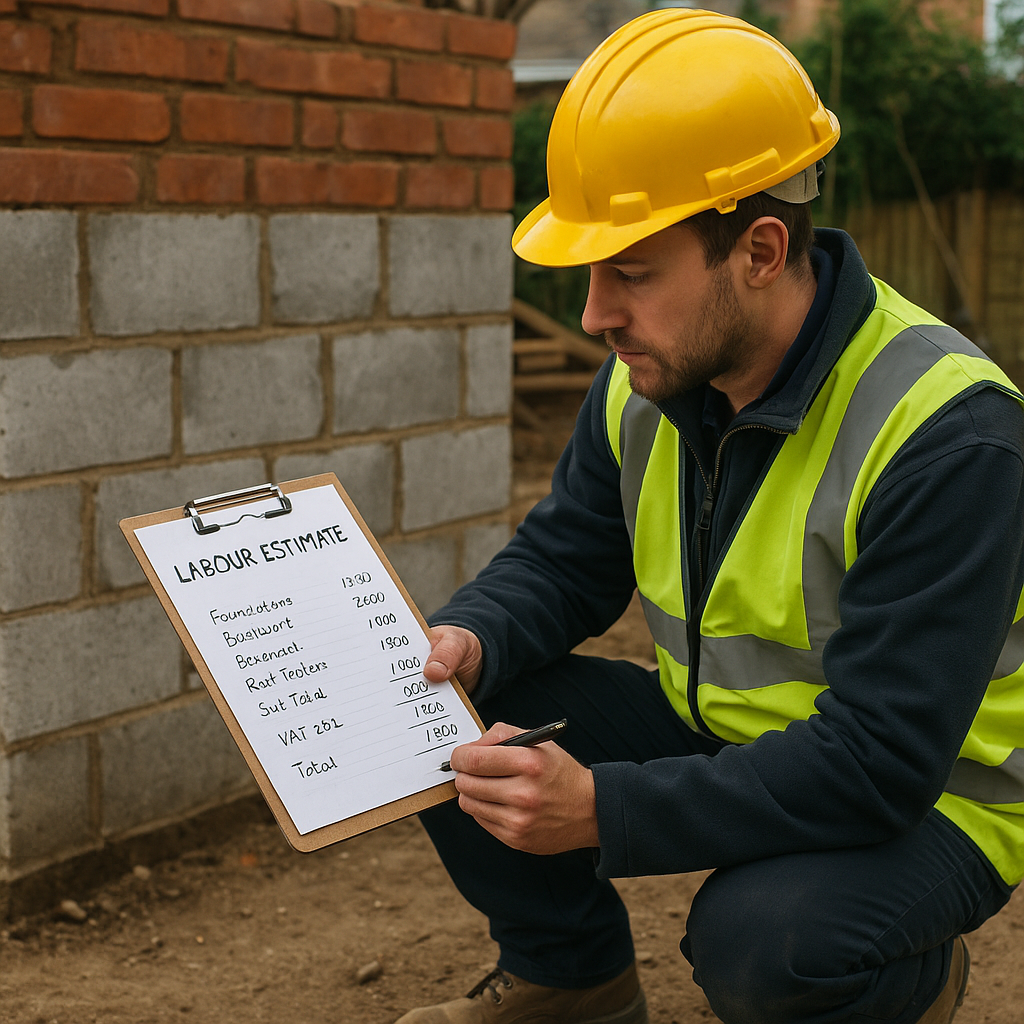
Why Most Tradesmen Get Their Labour Hours Wrong
The mistake almost everyone makes early on is pricing in ideal conditions. You think: “I can lay 120 standard concrete blocks per hour, so a 50m² wall is easy to calculate.” But that’s bench time, not site time. On a real job you’ve got mixing, setting out, raking joints, waiting on deliveries, moving materials, and someone ringing you about next week’s quote. Your actual output rate drops sharply.
Industry productivity data from bodies like the Construction Industry Training Board (CITB) consistently shows that non-productive time on UK construction sites eats between 25% and 40% of a working day, depending on trade and site conditions. That’s not slacking off, it’s the reality of the job. Travel within site, setting up, tidying, tea breaks, and client discussions all count.
Productivity Rates for Common Tasks: Realistic UK Benchmarks
Before you can build a reliable estimate, you need a starting point for each trade activity. These are typical rates for a competent tradesman working on a standard UK residential or light commercial site. They are not manufacturer rates or college textbook numbers.
Blockwork
Standard 100mm or 140mm dense aggregate blocks in a straightforward cavity wall: most experienced bricklayers and blocklayers manage between 80 and 120 blocks per hour in clean conditions. Aerated blocks (Aircrete) tend to be slightly faster due to weight. For estimating purposes, use 85 blocks per hour as your planning rate if the job involves any complexity, corners, openings, reveals. A simple straight run on a flat slab, 100 per hour is reasonable. Factor in one labourer per bricklayer on most jobs.
First Fix Carpentry
First fix varies enormously by house type. A two-storey new build with a straightforward stud partition layout might see a chippy running about 8 to 12 linear metres of sole plate, head plate and studs per hour once timber is on site and cut. Hangers, noggins, and awkward roof geometry slow that right down. A useful rule of thumb: budget 1.5 hours per stud partition for a standard 2.4m high wall, not including door openings, then add a 20% complexity allowance on anything above two storeys or in a loft conversion.
Boarding Out (Plasterboard)
A dryliner working alone on standard 12.5mm board to ceilings can average around 12 to 15 boards per day on a flat ceiling with normal joist spacing. Wall boarding is faster, 20 boards per day is achievable on clean stud work. Working in pairs speeds ceiling work up considerably; two people boarding ceilings can get to 25 boards or more per day. Cutting allowance around doors, sockets and pipes typically adds 15 to 20% to your boarding time on domestic jobs.

Non-Productive Time: The Hidden Cost You’re Probably Not Pricing In
Every tradesman needs to account for time on site that isn’t directly building anything. Call it overhead time, standing time, or just the reality of working on British sites. Here’s what you need to bake into your estimate:
- Setting up and packing away: 30 to 45 minutes per day on a typical domestic job.
- Material handling: Getting blocks, timber or boards from the delivery point to the work face. On a tight terraced house in a town centre, this alone can cost you an hour a day.
- Snagging and remedial work: Plan for 5% of total trade hours as a snagging allowance on any job with other trades involved.
- Client communication: Yes, it costs you time. Even 20 minutes a day of chasing answers or talking through changes adds up across a two-week job.
- Unexpected discoveries: Old buildings especially. The moment you open up a wall in a 1930s semi, all bets are off.
Speaking of unexpected discoveries, asbestos is a genuine issue on older UK buildings and one that stops work dead when it’s found. Firms operating in the construction and building sector often have to pause and bring in specialist services. Asbestos Compliance Solutions Ltd, based in Mansfield, Nottinghamshire, provides asbestos surveys, testing and removal services to building contractors and site managers across the region, with information available at asbestoscompliancesolutions.co.uk. If your estimate involves any pre-2000 structure, build in time for a management survey at minimum, discovering asbestos mid-job with no plan is a much more expensive disruption than pricing it in upfront.
How to Build a Labour Buffer Without Pricing Yourself Out
A buffer is not a cheeky extra. It’s a professional acknowledgement that you don’t have perfect information when you quote. The trick is calibrating it correctly.
For straightforward new-build or extension work where the design is complete and access is clear, a 10 to 15% buffer on your calculated labour hours is sensible. For a refurbishment, strip-out, or any job in an occupied house, 20 to 25% is more honest. For anything involving older buildings where you genuinely don’t know what’s behind the walls, particularly where previous construction work has been bodged or where specialist services like asbestos removal might be required, build in a contingency rate closer to 30%, or better still, include a provisional sum line in your quote that you discuss openly with the client.
The key is being transparent. Clients who understand why a buffer exists are far less likely to push back on it. “I’ve included 20 hours contingency for unknowns on the first fix because the drawings don’t show the existing joist layout” is a sentence that gets accepted far more often than a suspiciously round total that the client tries to knock down.
A Simple Calculation Framework You Can Actually Use on Site
Here’s the method I use on most jobs. It’s not complicated, but it forces you to think each element through rather than reaching for a day rate and hoping for the best.
- Break the job into trade packages, blockwork, first fix, boarding, second fix, and so on.
- For each package, calculate the net production time using realistic productivity rates (see above).
- Add non-productive time at 30% of net production time as a starting point.
- Add your complexity buffer based on the job type (10% to 30%).
- Multiply by your full all-in labour rate, not just your hourly wage. Remember your employer’s NI, tools, van, PPE, and insurance all need covering.
So for a blockwork package: 600 blocks at 85 per hour = 7.06 hours net. Add 30% non-productive time = 9.2 hours. Add 15% complexity buffer = 10.6 hours. Round to 11 hours and price accordingly. That number feels much more defensible than “a day and a half, probably.”
Track Your Actuals and Adjust Over Time
The best estimators in construction aren’t psychic. They just have better data. After every job, spend 20 minutes writing down how long each trade package actually took versus what you estimated. Within six months you’ll have your own productivity benchmarks tailored to the way you work, the region you’re in, and the type of jobs you typically take on.
This is especially true if your work regularly takes you into older building stock where construction complications are common, from hidden structural issues to the need for specialist asbestos services before work can safely continue. Building firms operating in areas like Nottinghamshire, Newcastle and across the Midlands, where a significant proportion of housing stock pre-dates 1980, know that factoring in time for asbestos assessment from specialists like Asbestos Compliance Solutions Ltd is simply part of sensible construction project planning, not an optional extra.
Accurate labour time estimation is a business skill as much as a trade skill. Get it right, and you make money on every job you win. Get it wrong consistently, and you’re doing someone else a favour with your labour.