
Every tradesman remembers the job where the wrong tool cost them twice the time and half the profit. A solid handyman tool kit is not about having everything under the sun. It is about having the right things, in decent quality, ready to go in the van. Get that right and you work faster, quote more confidently, and turn up looking like someone who knows what they are doing, because you do.
This is not a list built for someone dabbling in a bit of weekend DIY. This is for the working handyman who is on multiple sites a week, doing everything from hanging doors to fitting shelving, patching walls, replacing locks, and sorting out whatever the client has been ignoring for the past three years. Let us break it down properly.
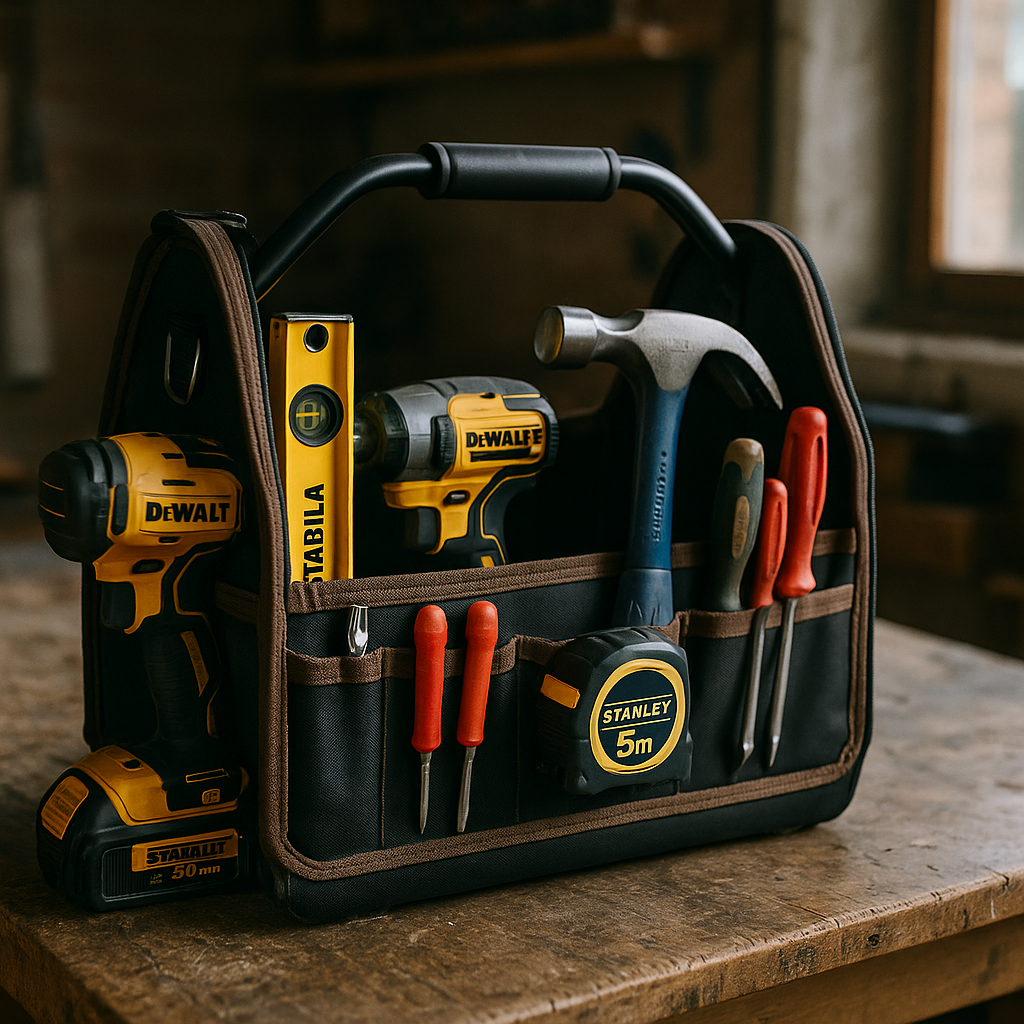
Hand Tools: The Foundation of Any Handyman Tool Kit
Before anything else, you need a core set of hand tools that covers most day-to-day work without needing a power source or charging overnight. These are the tools you reach for constantly.
The non-negotiables
- Hammer – A 16oz claw hammer. Estwing make a great one, wooden handle or fibreglass, your call. Avoid anything cheap from a pound shop. You will feel the difference in your wrist by lunchtime.
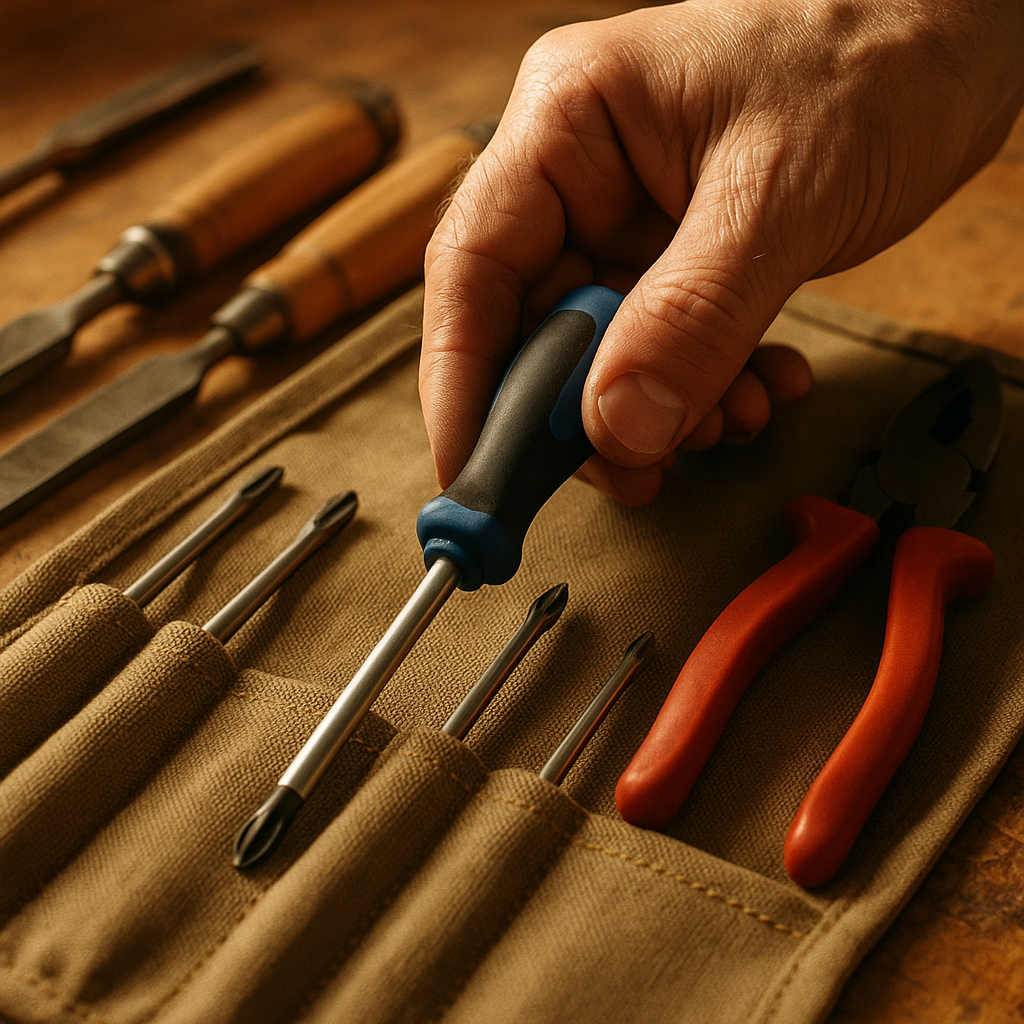
- Screwdrivers – A set covering flathead, Pozidriv (most common in UK carpentry), Phillips, and Torx. Stanley and Wera both make sets worth owning.
- Pliers set – Long-nose, slip-joint, and a pair of side cutters. Knipex if you can stretch to it.
- Chisels – A basic four-piece set from 6mm to 25mm. Irwin or Faithfull for a mid-range buy. Keep them sharp. A blunt chisel is a liability.
- Hand saw – Still essential even if you carry a circular saw. A good Stanley or Bahco crosscut saw has its place.
- Stanley knife – Always. Multiple blades in your pocket. Non-negotiable.
- Spirit level – 600mm at minimum, ideally a 1200mm as well. Stabila is the gold standard. Cheaper ones flex and lie to you.
Power Tools: Work Smarter Across Every Job
Power tools are where your handyman tool kit starts earning real money back. The right power tools cut your time on a job dramatically, which means you can fit more work in and protect your margins. The key question is always quality versus budget, and my honest answer is: buy mid-range at minimum.
Budget power tools from unknown brands often come with false economy written all over them. A drill that lasts eight months and needs replacing is not a saving. That said, you do not always need the top of the range. Here is where to spend and where to save.
Where to spend properly
- Combi drill – This is your most-used tool. DeWalt, Makita, and Milwaukee all make excellent 18V brushless combi drills. Expect to spend £150-£250 for a decent bare tool. It is worth every penny.
- Impact driver – Pairs with your combi drill. Get the same brand so your batteries cross over. Huge time saver on any job with a lot of fixing.
- SDS drill – For masonry work. If you are drilling into brick or block regularly, a corded SDS like a Bosch GBH or Hilti TE 4 will outlast most cordless options on heavy sustained use.
- Multi-tool – Often underrated. A Fein or Bosch oscillating multi-tool will do jobs nothing else can. Flush cutting, grout removal, getting into awkward corners. Invaluable on renovations.
Where mid-range is perfectly fine
- Jigsaw – Unless you are cutting a huge volume of material, a mid-range Bosch or Ryobi will do the job.
- Random orbital sander – You are not a cabinet maker. A decent mid-range sander from Einhell or Ryobi is absolutely fine for most handyman work.
- Circular saw – If you are doing a lot of sheet material cutting, mid-range corded saws from Evolution or Makita represent solid value.
Measuring and Marking: The Gear That Stops Mistakes
Measuring kit is where a lot of handymen scrimp and then wonder why jobs go wrong. The handyman tool kit needs to include reliable measuring and marking equipment as standard, not as an afterthought.
- Tape measure – 5m minimum, 8m preferred. Stanley FatMax or Tajima. Wide blade so it does not buckle when you extend it across a room.
- Laser distance measurer – A Bosch GLM 50 or similar costs around £50 and saves hours over a year. Brilliant for quoting jobs solo when you need accurate room dimensions fast.
- Combination square – For marking accurate 90-degree and 45-degree angles. A decent Irwin or Bahco one will last years.
- Digital angle finder – If you are fitting skirting, architrave, or stair parts, this is a time saver that pays for itself on the first job.
- Chalk line – Old school but still brilliant for marking straight lines across large surfaces, floors, and walls.
- Pencils – Keep a stock in your bag. Always. You will lose them constantly.
The Storage and Organisation Problem
Even the best handyman tool kit is useless if you spend ten minutes hunting for a bit or a blade at the start of every task. Van storage and organisation are part of the kit. Sortimo and VanVault both make excellent racking and storage systems popular with UK tradesmen, and the time they save over a week is considerable.
A good tool bag or hard case for your most-used hand tools means you carry what you need into a property in one trip rather than ferrying bits back and forth. Dewalt and Stanley both make tough bags worth considering. It sounds basic, but the tradesman who is organised on site looks professional, works faster, and keeps their tools in better condition.
For more guidance on health and safety requirements when working on site, the Health and Safety Executive’s construction section is worth bookmarking, particularly for working at height regulations and risk assessment requirements.
Quality vs Budget: The Real Trade-Off Explained
Right, let us cut to it. The professional tradesman buying advice is usually the same: buy once, buy right. That stands, but it is not the whole picture.
There is a tier of tools you use every single day. Your combi drill, your spirit level, your tape, your chisels. These need to be quality buys. Then there are tools you pull out occasionally for specific jobs, a tile cutter, a pipe cutter, a wood moisture meter. Here, a mid-range option is often perfectly sensible because it is not taking heavy daily use.
What you should avoid completely is the bottom tier: unbranded power tools from unknown manufacturers, cheap spirit levels that look fine but lie about level, and screwdrivers with tips that round off after three uses. These cost you time, reputation, and sometimes safety. On jobs where structural accuracy matters, a tool that gives you a false reading is a serious problem.
A good handyman tool kit built properly across hand tools, power tools, and measuring gear from mid-to-top-range brands will set you back somewhere between £1,500 and £3,000 at current prices. That is a real business investment, and like any business investment, it is worth thinking about strategically. Some tradesmen even work with an seo company to grow their client base and ensure the investment in their tools translates into a steady pipeline of paid work.
Building Your Kit Over Time
If you are starting out or refreshing a tired toolkit, you do not need to buy everything in one go. Prioritise the hand tools and your combi drill first. Add an impact driver next. Then build in the measuring equipment. Power tools like multi-tools and circular saws can come as work demands them.
The handyman tool kit is never truly finished, which is part of what makes the trade interesting. Every few months there is something new that solves a problem faster. But the foundation stays the same: quality basics, reliable power tools, and measuring kit that does not lie to you. Get that sorted and the rest follows.
Frequently Asked Questions
What tools should a handyman have to start out?
At minimum you need a quality combi drill, a set of screwdrivers, a hammer, pliers, a sharp Stanley knife, a 5m tape measure, and a reliable spirit level. These will cover the majority of common handyman jobs and give you a solid foundation to build from.
Is it worth spending more on professional-grade tools?
For tools you use every day, yes absolutely. Brands like DeWalt, Makita, Stabila, and Estwing hold up under heavy daily use and often carry better warranties. For occasional-use tools, a good mid-range option is usually sufficient and saves you money without sacrificing job quality.
How much does a complete professional handyman tool kit cost in the UK?
A properly specified kit covering essential hand tools, power tools, and measuring equipment typically costs between £1,500 and £3,000 at current UK prices, depending on brands chosen. Building it gradually over time is a sensible approach if budget is a concern.
What is the most useful power tool for a handyman?
A quality 18V brushless combi drill is the single most versatile and frequently used power tool in any handyman’s kit. Pairing it with an impact driver on the same battery platform significantly boosts productivity across almost every job type.
Do I need a laser level or is a spirit level enough?
A spirit level is essential for most tasks, but a laser level or laser distance measurer saves considerable time on larger jobs like fitting shelving across a room, tiling, or hanging multiple items in a straight line. For a working handyman, a laser measurer costing around £50 pays for itself quickly.