

Insulation is one of those jobs where doing it right first time actually saves everyone grief further down the line. Homeowners get lower energy bills, you get fewer call-backs, and the building performs the way it should. With energy costs still biting hard and Part L of the Building Regulations continuing to tighten up standards, picking the right product matters more than ever. This is a straight-talking breakdown of the best insulation materials UK tradesmen and capable DIYers are using right now, covering thermal performance, cost, and what to watch out for on site.
Why Insulation Choice Matters More Than Ever in 2026
The UK has some of the leakiest housing stock in Europe. According to the Energy Saving Trust, heating accounts for around 55% of what a typical household spends on energy bills each year. Proper insulation is the single biggest lever you can pull to bring that down. It also affects everything from planning sign-off to SAP calculations, so getting the specification wrong is not just a comfort issue, it can cause jobs to fail at inspection.
The key metric to understand is thermal resistance, expressed as an R-value (m²K/W). The higher the R-value, the better the material resists heat flow. Some products are also rated by their lambda value (W/mK), which measures thermal conductivity. Lower lambda means better performance per millimetre of thickness. Both figures appear on manufacturer data sheets, and you should always check them before specifying anything.
Mineral Wool: The Workhorse Option
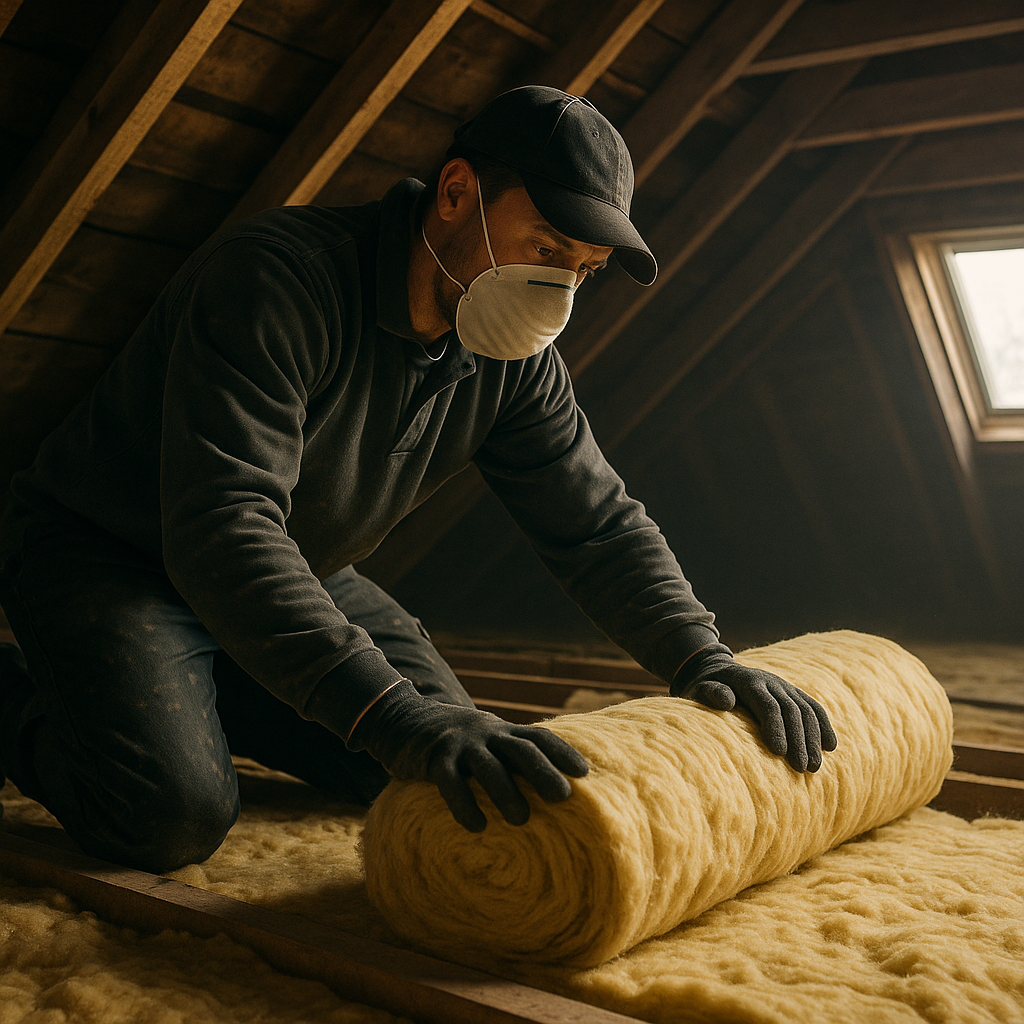
Mineral wool, which covers both glass wool and rock wool products, is what most tradesmen reach for first, and for good reason. It is widely available from builders’ merchants across the UK, competitively priced, and easy to cut and fit between studs or joists. Brands like Knauf and Rockwool supply consistently reliable product, and you will find it at most major merchants including Buildbase and Travis Perkins.
Glass wool batts for a standard 100mm stud wall typically achieve an R-value of around 2.5 to 2.7 m²K/W. Rock wool is slightly denser, performs better acoustically, and has a higher melting point, making it the better call where fire performance is a consideration. Costs run at roughly £4 to £6 per square metre depending on thickness and supplier.
Fitting is straightforward. Cut slightly oversized so the batt friction-fits without gaps, keep any foil facing towards the warm side of the construction, and always wear gloves and a dust mask. The fibres are unpleasant on skin and in the lungs if you are not careful.
Rigid Foam Boards: Best for Tight Spaces
When you are insulating below a floor slab, a flat roof, or a wall where you cannot afford to lose much depth, rigid foam boards are where you look. There are three main types:
- Expanded Polystyrene (EPS): Cheapest of the three. R-value around 3.3 to 3.8 m²K/W per 100mm. Fine for floors and cavity walls but not the slimmest solution.
- Extruded Polystyrene (XPS): Slightly better thermal performance than EPS and more moisture-resistant, which makes it the right call under a screed or in a basement situation. Expect to pay 15 to 20% more than EPS.
- Polyisocyanurate (PIR): This is the premium option. Brands like Celotex and Kingspan produce PIR boards with lambda values as low as 0.022 W/mK, giving you excellent performance at reduced thickness. A 100mm PIR board can achieve R-values above 4.5 m²K/W. Costs are higher, typically £10 to £18 per square metre, but the space saving often justifies it in a retrofit.
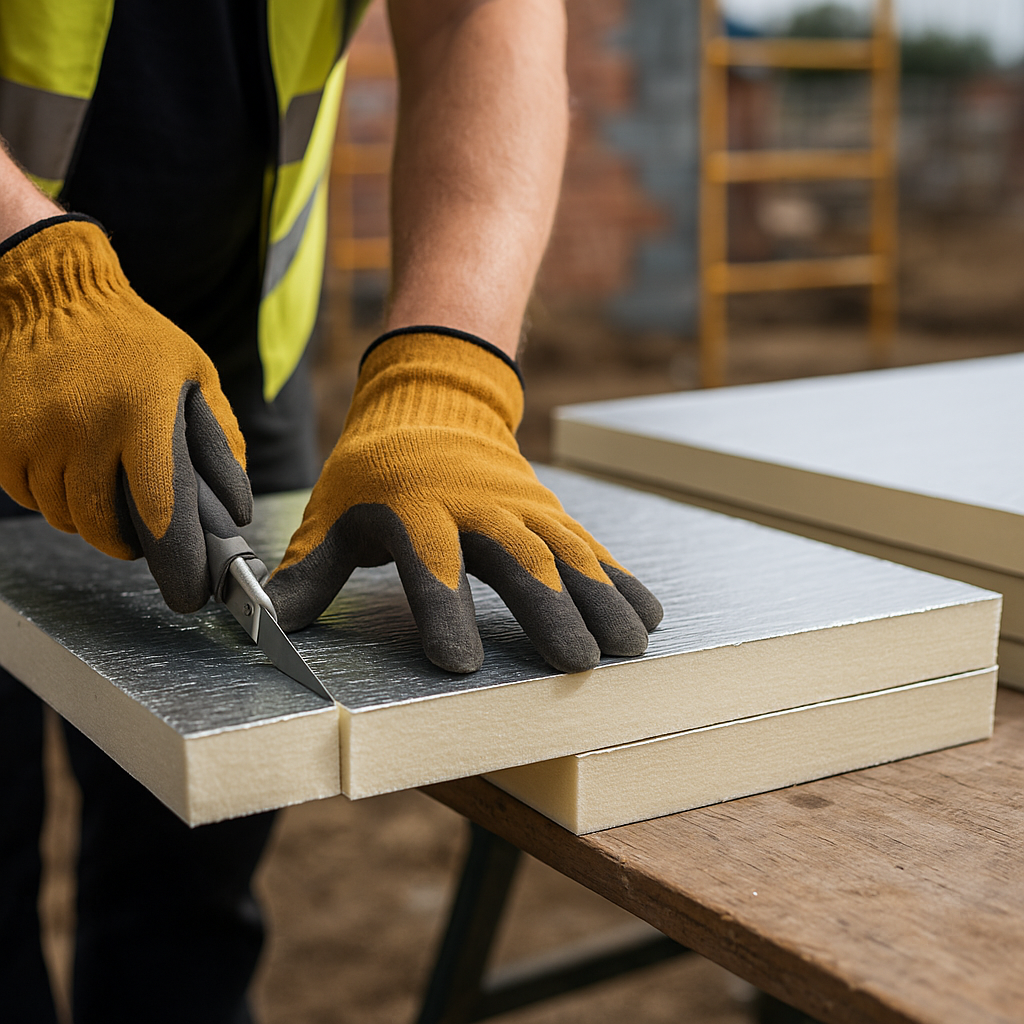
When cutting rigid boards, a sharp handsaw or a Stanley knife and straight edge is all you need for EPS. PIR cuts cleanly with a fine-tooth saw. Always tape joints between boards with foil tape to eliminate cold bridging. Do not leave exposed PIR boards in habitable spaces without a fire-rated covering such as plasterboard, this is a Building Regulations requirement, not just good practice.
Spray Foam: High Performance, High Caution
Spray polyurethane foam (SPF) gets a mixed reception on site, and honestly, the reputation is partly deserved. When applied correctly by a qualified installer in the right application, such as sealing around penetrations or insulating the underside of a pitched roof, it performs brilliantly. R-values for closed-cell spray foam typically sit above 6.0 m²K/W per 100mm, which is the best of any mainstream product.
The problem is that poorly applied spray foam in loft spaces has caused real headaches for mortgage lenders and surveyors. The Royal Institution of Chartered Surveyors has flagged this as an issue that can affect property valuations and mortgage approvals. If a customer asks you about spray foam in their roof void, have that conversation honestly. Stick to professional application only, and make sure the product and installer both carry relevant BBA certification.
Natural and Eco-Friendly Insulation Options
There is growing demand for sustainable insulation, particularly on eco-builds and retrofit projects where embodied carbon is part of the brief. A few worth knowing:
- Sheep’s wool: Breathable, naturally moisture-managing, and non-irritant to handle. Good fit for traditional or timber-frame construction. Performance sits around 3.5 m²K/W per 100mm. More expensive than mineral wool but increasingly specified on heritage and sustainable builds.
- Cellulose (recycled newspaper): Blown into cavities or roof spaces, it achieves solid performance and has very low embodied energy. Requires specialist equipment to install but the material cost is reasonable.
- Hemp and flax batts: A growing market in the UK, especially for self-builders and Passivhaus projects. Handles similarly to mineral wool but fully vapour-permeable.
Natural materials typically cost more per square metre, but the right client on the right project will see the value. It is worth knowing your options here as specifications are shifting.
Insulation for Common UK Scenarios
Here is a quick reference for where each material tends to land:
- Loft insulation (cold roof): Glass wool roll or batt, 270mm depth across joists. This is the most cost-effective improvement in most homes.
- Stud partition walls: Mineral wool batt, friction-fit between studs.
- Flat or warm roof: PIR board above deck, taped joints, minimum 150mm for compliance in most situations.
- Solid floor retrofit: XPS or PIR board under screed, minimum 70mm, DPC below.
- External wall insulation (EWI): EPS or mineral wool board fixed to external face with render finish over. Check with your local authority on planning requirements before starting.
For more guidance on compliance, the GOV.UK approved documents index has the full text of Approved Document L, which covers conservation of fuel and power in both new builds and existing dwellings.
A Few Things Worth Remembering on Site
Whatever material you are using, gaps are the enemy. A small uninsulated void in a wall or floor can account for a disproportionate amount of heat loss due to convection. Take the time to cut and fit properly. Use off-cuts to fill awkward corners. Tape every joint in rigid board installations.
Ventilation matters too. Insulating a cold roof without maintaining eaves-to-ridge airflow can lead to condensation and structural rot. The two most common insulation-related failures I see are gaps in installation and blocked ventilation paths. Both are avoidable if you think the job through before you start cutting.
The best insulation materials UK tradesmen use are the ones that match the application, not just the cheapest thing on the shelf. Get the product right, fit it properly, and the job will stand up for decades.
Frequently Asked Questions
What is the best insulation material for a UK loft?
Glass wool roll or batt insulation is the most practical and cost-effective choice for a cold loft. Current guidance recommends a total depth of around 270mm laid in two perpendicular layers across and between the joists. It is widely available, easy to install, and delivers strong thermal performance.
How much does home insulation cost in the UK in 2026?
Costs vary significantly by material and application. Mineral wool for a standard loft might cost £300 to £600 in materials for a typical semi-detached house. PIR board for a flat roof can run to £2,000 to £5,000 fitted, depending on area and complexity. External wall insulation tends to be the most expensive option, often £8,000 to £15,000 for a whole house.
Is PIR insulation board better than mineral wool?
PIR board achieves higher thermal performance per millimetre of thickness, making it the better choice when space is limited, such as flat roofs, floor builds, or slim-wall applications. Mineral wool is easier to handle in stud walls and lofts and costs significantly less per square metre, so it remains the better all-round option for many standard applications.
Can spray foam insulation affect my mortgage in the UK?
Yes, it can. Many UK mortgage lenders and surveyors treat spray foam in roof voids as a red flag, as it can obscure the structural condition of roof timbers and be difficult to remove. The RICS has issued guidance on this issue. If you are considering spray foam, speak to a specialist and ensure any installer holds current BBA certification.
What is the minimum insulation required under UK Building Regulations?
Approved Document L sets the standards, and requirements vary by element type. For example, a new roof construction typically needs a U-value of 0.15 W/m²K or better, whilst new external walls require 0.18 W/m²K. Exact figures depend on whether you are working on a new build or an existing dwelling, so always check the relevant section of the approved documents for your project.
Leave a Reply